获得 Business Analyst 许可后可用。
The Gap Analysis Report is used to analyze a market by ZIP Code, or other lower level of geography, using segmentation profile information. A market is analyzed with the number of current customers, the number of core and developmental households, the customer penetration, the number of expected households, and the gap between the two customer values. For example, this report will compare the actual number of customers to the number of expected customers for all ZIP Codes in Colorado.
The report starts by creating a Customer Tapestry Profile Report based on the target and base segmentation profiles. This report calculates the percent penetration by dividing the target total for each segment by the base total and multiplying by 100. For example, in the report below, there are 1,203 customers in segment 6: Sophisticated Squires and 71,027 households in the base. Thus, the percent penetration is 1.69 percent.
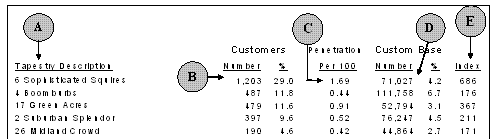
Using this Customer Tapestry Profile, an expected number of customers based on the number of households in a given geographic area and their Tapestry composition is calculated. For example, if there are 100 households in the 6: Sophisticated Squires segment in a geographic area, multiply 100 by 1.69 percent to result in 1.69 expected households in this segment for this area. This same calculation is performed on all 66 segments and summed to obtain an expected customer count for each geographic area. This is referred to as the Expected Customers in the Gap Analysis Report.
The gap refers to the difference between the actual number of customers you currently have and the total potential number of customers who would be expected in your market area. The gap is the difference between actual customers and expected customers.
The report sorts the geography level by count of actual customers from highest to lowest. Geography units with a large negative gap are underperforming based on the Tapestry profile of the market. The geography units that have a large negative gap and contain a large base of potential customers can be targeted using different marketing initiatives.